The European home decor market is large and growing fast. With market size reaching USD 204B in 2024 and a clear trajectory toward USD 283B by 2033, the opportunity for boutique entrepreneurs is real. But size alone does not guarantee success. Boutique owners face intense competition from global retail chains, shifting consumer expectations, and the ongoing challenge of building trust in new markets. This guide covers the marketing strategies that work specifically for Scandinavian-inspired interior boutiques, from digital foundations to localization tactics and luxury positioning.
Table of Contents
- Understanding the Scandinavian home decor market
- Digital marketing essentials for interior boutiques
- Luxury positioning and experiential retail
- Localizing your boutique marketing for Scandinavian regions
- Expert perspective: The real barriers and breakthroughs in boutique marketing
- Franchise opportunities for Scandinavian-inspired interior boutiques
- Frequently asked questions
Key Takeaways
| Point | Details |
|---|---|
| Scandinavian market growth | Europe’s home decor market is booming, with growth driven by sustainability and hybrid living trends. |
| Boutique marketing must be localized | Success depends on tailoring digital and experiential strategies to Nordic consumer values and regional nuances. |
| Luxury and proof assets drive results | Elevating branding with editorial social content, AR showrooms, and local trust assets supports higher conversion rates. |
| 80/20 social content works | Balanced branding and promotion on social channels build authenticity and boost engagement for boutiques. |
| Franchise-ready solutions exist | Entrepreneurs can tap proven franchise models for Scandinavian boutique expansion with expert marketing support. |
Understanding the Scandinavian home decor market
Before you invest in marketing, you need to understand what you are marketing into. The European home decor sector is not a single market. It is a collection of regional markets with distinct preferences, spending habits, and expectations.
The projected market growth to USD 283B by 2033 is driven by several forces: rising disposable incomes, the ongoing shift to hybrid work (which has pushed consumers to invest more in their home environments), and a clear preference for sustainable, quality products over cheap, disposable alternatives. IKEA leads the mass market, but that actually creates space for boutique operators who can offer something more curated and premium.
| Market factor | Impact on boutique strategy |
|---|---|
| Hybrid work trend | Higher demand for home office and living space products |
| Sustainability requirements | ESPR regulations raise the bar for eco credentials |
| Online sales growth | Digital presence is now non-negotiable |
| Regional nuances | Messaging and product mix must adapt by country |
| Trust over hype | Nordic consumers respond to proof, not bold claims |
Consumer expectations in Scandinavian markets are specific. Buyers in Sweden, Norway, Denmark, and Finland value authenticity, functional design, and environmental responsibility. They are skeptical of aggressive sales tactics and respond better to honest, evidence-based communication. This is not a market where flashy promotions drive conversions. Credibility and consistency are what build long-term customer relationships.
Sustainability is not optional in this market. The EU’s Ecodesign for Sustainable Products Regulation (ESPR) is reshaping how products are manufactured and marketed across Europe. Boutiques that can demonstrate genuine eco credentials, whether through certified suppliers, responsible packaging, or transparent sourcing, will have a meaningful advantage. Consumers are increasingly checking these claims, and regulators are too.
“Scandinavian consumers prioritize trust and proof over marketing hype. Boutiques that lead with authenticity and sustainability credentials consistently outperform those that rely on traditional promotional tactics.”
If you are exploring the interior design business opportunity in Europe, understanding these market dynamics is the starting point for every marketing decision you make.
Digital marketing essentials for interior boutiques
A strong digital presence is the foundation of boutique marketing in 2026. This does not mean having a website. It means having a website that works, a content strategy that attracts the right audience, and measurement systems that tell you what is actually driving revenue.
Here is a structured approach to building your digital marketing engine:
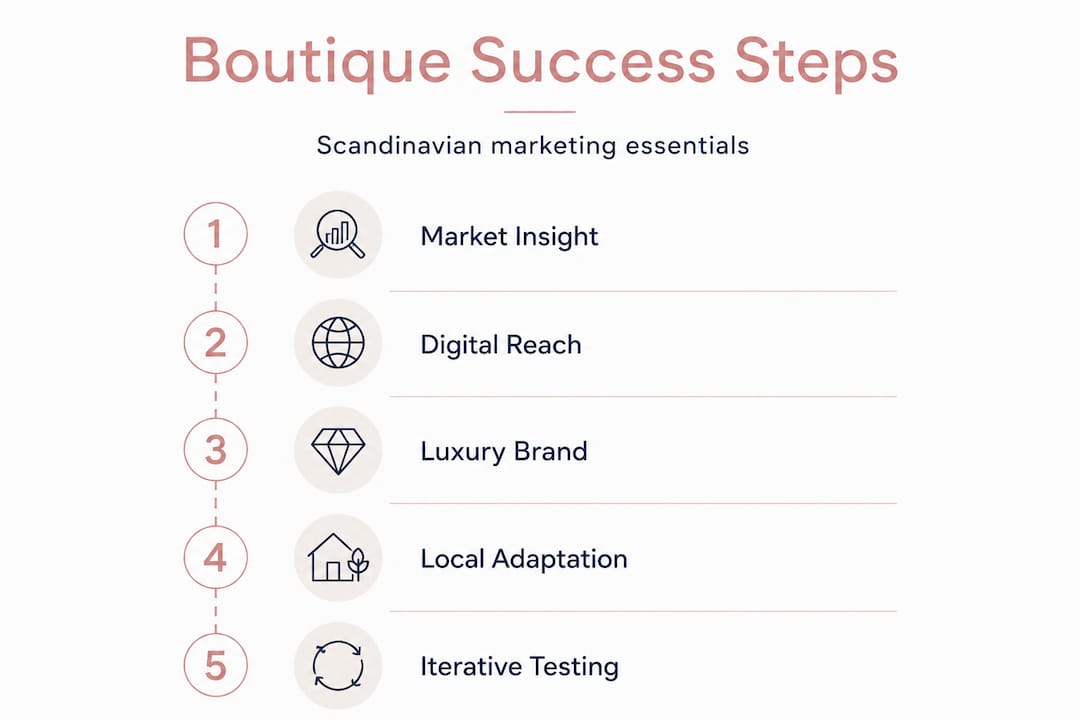
Optimize your website for local search. Create localized landing pages for each target market. Use unique product descriptions rather than manufacturer copy. Build category guides that answer real buyer questions, such as “how to choose Scandinavian lighting for a small apartment.” These pages attract organic traffic and establish your boutique as a knowledgeable source.
Build trust through testimonials and storytelling. Customer reviews, before-and-after photos, and real stories from buyers are more persuasive than any promotional copy. Feature these prominently on product pages and your homepage.
Apply the 80/20 social content rule. Digital marketing for boutiques works best when 80 percent of your social content focuses on inspiration, education, and brand storytelling, while only 20 percent is directly promotional. This ratio builds an engaged audience that trusts you before you ask them to buy.
Set up email automation. Capture emails through your website and use automated sequences to nurture leads. A welcome series, a post-purchase follow-up, and a re-engagement campaign for inactive subscribers are the three core sequences every boutique needs.
Track the right metrics. Vanity metrics like follower counts tell you very little. Focus on Return on Ad Spend (ROAS), Customer Acquisition Cost (CAC), Customer Lifetime Value (LTV), and Conversion Rate (CVR). These numbers tell you whether your marketing is actually profitable.
| Metric | What it measures | Why it matters |
|---|---|---|
| ROAS | Revenue per dollar of ad spend | Tells you if paid campaigns are profitable |
| CAC | Cost to acquire one customer | Helps you set realistic marketing budgets |
| LTV | Total revenue from one customer | Guides investment in retention programs |
| CVR | Percentage of visitors who buy | Reveals website and landing page performance |
A case study from Norwegian boutique SEO shows that a local shop achieved significant organic growth and higher conversions by combining unique product descriptions, targeted category guides, localized pages, and strategic outreach. The results did not happen overnight, but the investment in structured SEO paid off consistently over time.
Pro Tip: Use paid social media to amplify your best-performing organic content. Short videos and customer proof assets (reviews, unboxing clips, room reveals) tend to generate the highest engagement and the strongest return when boosted with a modest ad budget. Start with a small test budget, measure ROAS, and scale what works.
For boutiques looking to build their SEO for home decor boutiques from the ground up, starting with a clear keyword strategy and localized content is the most efficient path to sustainable organic traffic. If you are evaluating an interior boutique franchise model, ask whether the franchisor provides SEO-ready website infrastructure, because building it from scratch is time-consuming and costly.
Luxury positioning and experiential retail
Digital marketing gets people to your door. Luxury positioning is what makes them stay, buy, and come back. Scandinavian interior boutiques operate in a premium segment, and that requires a different approach than standard retail marketing.
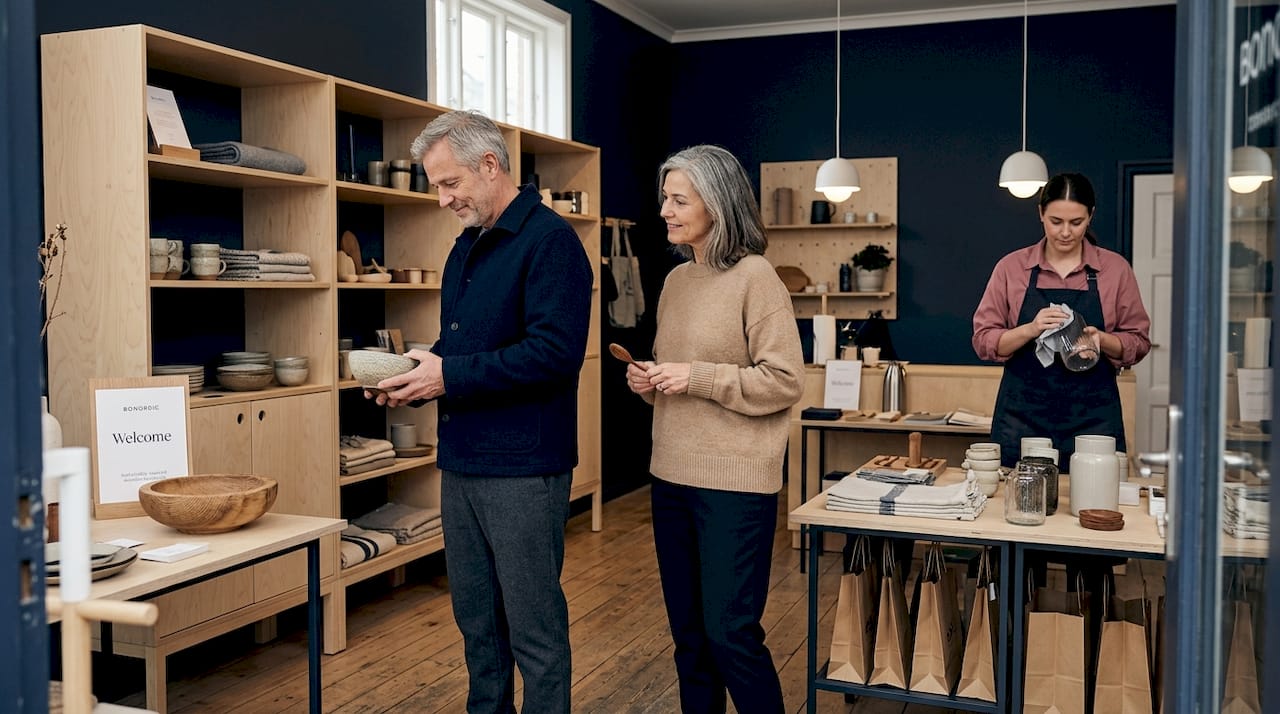
Luxury home decor marketing is built on several core principles: scarcity, personalization, editorial content, and experiential retail. Each of these plays a specific role in building a brand that commands premium prices and loyal customers.
Key tactics for luxury boutique positioning:
- Scarcity and limited releases. Offer limited-edition collections or exclusive colorways available only through your boutique. This creates urgency without discounting.
- Editorial content. Treat your social media and blog like a design magazine, not a product catalog. Feature interior design tips, architect interviews, and lifestyle content that positions your boutique as a cultural authority.
- AR and VR showroom tools. Augmented reality tools that let customers visualize furniture in their own homes reduce purchase hesitation significantly. These tools are increasingly accessible and expected in the premium segment.
- Personalization and clienteling. Track customer preferences and purchase history. Send personalized recommendations. Recognize returning customers by name. These small gestures create the kind of loyalty that no discount can buy.
- Experiential in-store events. Host interior design workshops, seasonal styling events, or product launch evenings. These events generate word-of-mouth, social media content, and direct sales in a single activity.
- Sustainability as a feature. In the premium segment, sustainability is not just a compliance requirement. It is a selling point. Certifications, supplier stories, and eco-friendly packaging all reinforce the value proposition.
Performance benchmarks to target: A UK interiors brand case study recorded a 51 percent purchase increase quarter-over-quarter, a 34 percent improvement in conversion rate, and Meta ROAS of 2.24, while Blume Interior achieved an average ROAS of 4.93 with a peak of 9.46. These numbers are achievable with the right creative strategy and consistent optimization.
The luxury boutique retail model works because it creates a complete brand experience rather than just a transaction. Every touchpoint, from your website typography to your packaging to how your staff greets customers, contributes to the perception of value. Boutiques that treat these details as secondary to product selection consistently underperform those that treat brand experience as a core business function.
Connecting luxury positioning to sustainable interior business practices is increasingly important in 2026. European consumers, particularly in Scandinavian markets, are making purchasing decisions based on a brand’s environmental stance. This is not a trend. It is a structural shift in consumer behavior.
Localizing your boutique marketing for Scandinavian regions
Understanding the broad market and building a strong digital and luxury foundation are necessary steps. But the boutiques that grow fastest are the ones that localize effectively. Scandinavian markets are not interchangeable. Sweden, Norway, Denmark, and Finland each have distinct consumer cultures, preferred channels, and communication norms.
Here is a practical localization framework:
Choose a beachhead market. Do not try to launch everywhere at once. Pick one market, establish proof of concept, and then expand. This lets you learn quickly and allocate resources efficiently.
Localize your trust assets. Translate testimonials, case studies, and reviews into the local language. Use local customers as proof assets wherever possible. A Norwegian customer review carries more weight with Norwegian buyers than a generic English-language testimonial.
Adapt your channel mix by market. The Nordic marketing playbook recommends short-form video and paid social for B2C audiences, while LinkedIn and Google Search work better for B2B outreach. The channel that drives results in one market may underperform in another.
Run weekly iteration cycles. Test messaging, creative, and offers on a weekly basis. Nordic consumers respond to simplicity and empathy. If your messaging feels generic or overly sales-driven, it will underperform. Iterate quickly based on real data.
Build an influencer program with local creators. Partner with interior design influencers who have genuine followings in your target market. Micro-influencers (10,000 to 100,000 followers) often deliver better engagement and conversion rates than large accounts.
Key localization actions by channel:
- Website: Translate all pages, use local currency, adapt product descriptions to local terminology
- Social media: Post in the local language, feature local interiors and lifestyles
- Paid media: Use geo-targeted campaigns with locally relevant creative
- Email: Segment by country and adapt messaging to local cultural norms
- Influencer: Source creators from the specific country, not just the broader Nordic region
“Tilbords, a Norwegian home decor retailer, allocated 65 percent of its budget to digital, with content driving 25 percent of traffic, a network of 50-plus influencer creators, a paid social ROAS of 4.2, and an omnichannel split of 58 percent physical and 42 percent e-commerce.”
This kind of structured, data-driven localization is what separates boutiques that grow from those that stagnate. If you are launching in Spain, the Nordic boutique strategy for Spain requires different creative and messaging than a launch in Denmark. Similarly, the Nordic boutique strategy for Denmark or the Nordic boutique strategy for France each demand their own localized approach to resonate with local buyers.
Expert perspective: The real barriers and breakthroughs in boutique marketing
Most boutique marketing guides focus on tactics. This one does too, but there is something more important to address: the mindset errors that cause well-funded boutiques to underperform.
The biggest mistake in Scandinavian boutique marketing is treating a luxury interior store like a generic retail operation. Generic retail competes on price, volume, and convenience. Luxury boutiques compete on trust, experience, and identity. When boutique owners apply generic retail tactics to a premium brand, they erode the very qualities that justify their price point.
Nordic consumers are particularly sensitive to this. They do not respond to urgency tactics, countdown timers, or aggressive discount promotions. These tactics signal low quality and damage brand credibility. What works instead is consistent proof: real customer stories, transparent sourcing information, honest product descriptions, and a brand voice that respects the buyer’s intelligence.
Sustainability certifications are another area where boutique owners often underinvest. Many treat eco credentials as a compliance checkbox rather than a conversion driver. In Scandinavian markets, this is a significant missed opportunity. Buyers in Sweden and Norway, in particular, actively research a brand’s environmental practices before making high-value purchases. Displaying certifications prominently, explaining your supply chain, and featuring your sustainability commitments in your marketing content can meaningfully improve conversion rates.
The interior design franchise lessons that matter most come from operators who committed to local adaptation from day one. They did not launch with a generic European strategy and hope it would work in Oslo or Copenhagen. They invested in local proof assets, local language content, and local influencer relationships before scaling their ad spend. The results consistently outperformed those who tried to scale first and localize later.
Iterative testing is the engine of growth in this sector. The boutiques that grow year over year are not the ones with the biggest budgets. They are the ones that test systematically, measure honestly, and adapt quickly. A weekly review of your key metrics, combined with a willingness to change what is not working, is more valuable than any single marketing tactic.
Franchise opportunities for Scandinavian-inspired interior boutiques
The marketing strategies covered in this guide are proven. But executing them effectively requires the right infrastructure: a localized website, a curated product catalog, supplier relationships, and operational support. Building all of this from scratch takes significant time and capital.
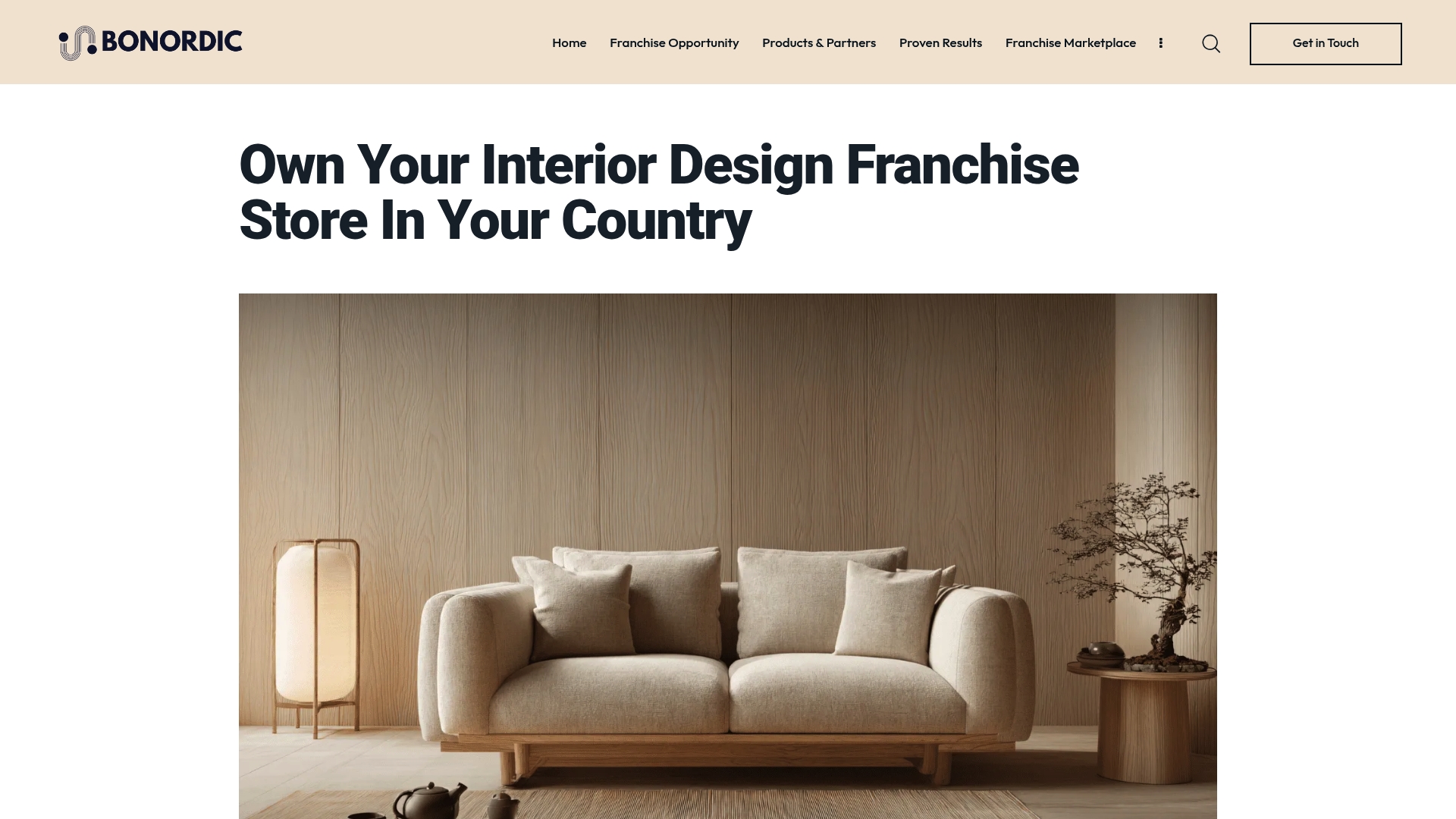
Bonordic offers a structured path for entrepreneurs who want to enter the Scandinavian interior design market without starting from zero. The Bonordic franchise rights model gives you protected territorial exclusivity, a fully localized online store, curated product sourcing from European suppliers, and ongoing operational support. You can focus on marketing and customer relationships while the infrastructure is already in place. Region-specific options are available, including Nordic design Spain for entrepreneurs targeting the Spanish market. If you want to understand exactly what the model includes and how it fits your market, the best next step is to book a franchise presentation and get the details directly.
Frequently asked questions
What makes Scandinavian interior boutiques stand out in Europe?
Scandinavian boutiques feature minimalist design, authenticity, sustainability certifications, and empathy-driven branding that resonate uniquely with European consumers. Nordic consumers value trust and proof over hype, which gives well-positioned boutiques a clear advantage over mass-market competitors.
How important is sustainability in boutique marketing?
Sustainability is essential; ESPR regulations and eco credentials influence buying decisions and trust, especially in Scandinavia and wider Europe. The projected market growth to USD 283B by 2033 is partly driven by consumers actively choosing sustainable brands over conventional alternatives.
What is the 80/20 social content rule for interior boutiques?
Spend 80 percent of social content on inspiration and branding and 20 percent on promotional messaging to maximize engagement and authenticity. Digital marketing for boutiques consistently shows that this ratio builds more loyal audiences than promotion-heavy content strategies.
How should marketing be localized for different Nordic countries?
Tailor messaging, proof assets, and influencer channels for each market; prioritize trust, simplicity, and region-specific adaptation for maximum impact. The Nordic marketing playbook recommends starting with one beachhead market and iterating weekly before expanding to additional regions.
What are key success benchmarks for boutique marketing campaigns?
High-performing campaigns see purchase lifts of 51 percent quarter-over-quarter, conversion rates up 34 percent, and strong ROAS metrics. The interiors brand case study benchmarks show that average ROAS of 4.93 and peak ROAS of 9.46 are achievable with consistent creative testing and audience optimization.